The Bezos Blueprint: Unveiling the Genius Behind Amazon's Early Days
· 8 min read
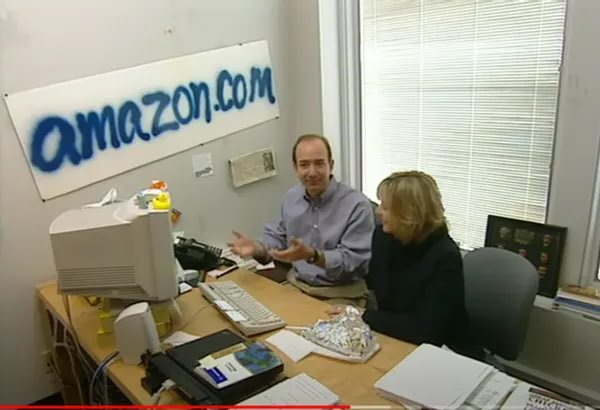
Picture this: It's 1994, and a young Jeff Bezos is about to make a decision that will change the course of his life—and the world.
(check out the entire version history of Amazon's website from 1994 to 2023)
Armed with a bold vision and an unwavering belief in the potential of the internet, he quits his lucrative Wall Street job to start an online bookstore in his garage.
Fast forward to today, and that bookstore has become a global empire, with Bezos' personal wealth surpassing the GDPs of entire nations.
But what set him apart in those early days? What were the key decisions and mindsets that propelled him to the pinnacle of the business world?
Jeff is probably the most optimistic person I've ever met. That was very clear from the start. I'd never been around someone that had amount of optimism. - Jason Fried
1. The Mission was Clear from Day Zero#
From the outset, Bezos had a crystal-clear vision for Amazon. The company's mission was simple yet ambitious:
"To be Earth's most customer-centric company where people can find and discover anything they want to buy online."
This unwavering focus on customer satisfaction and the desire to create an unparalleled online shopping experience would become the guiding light for Amazon's meteoric rise.
2. Mindset is the Key#
Looking into Jeff Bezos's early success, one thing stands out as key: his unstoppable positive attitude.
Jason Fried, the founder of 37signals and Basecamp, recalls, "Jeff is probably the most optimistic person I've ever met.
That was very clear from the start.
I'd never been around someone that had that amount of optimism."
This unwavering belief in the possible would become the driving force behind Amazon's meteoric rise.
3. Lean into Negative Feedback#
From day one, Bezos understood that in the digital age, customer satisfaction was paramount.
He recognized that on the internet, word-of-mouth spreads like wildfire. "Everybody is a publisher" he noted.
"They blog and they email, and they can turn nasty very quickly."
This realization led him to prioritize customer experience above all else, even going so far as to redesign Amazon's packaging after receiving an email from an elderly customer who struggled to open it.
This obsessive focus on the customer would become a hallmark of the Amazon brand.
4. Great Product has a Feeling#
Jeff was adamant about not releasing a crappy product.
Every detail counted.
Every step of the journey from browsing to receiving packages.
When one elderly woman sent an email to the company saying she loved ordering books from the site but had to wait for her nephew to come over and tear into the difficult-to-open packaging, Bezos had the packaging redesigned to make it easier to open
5. Patents as a Moat#
In the early days of e-commerce, many entrepreneurs overlooked the importance of patents.
Not Jeff Bezos.
He recognized that innovation was the key to staying ahead of the competition, and he was determined to protect Amazon's groundbreaking ideas.
When Amazon introduced 1-click shopping, a revolutionary feature that streamlined the purchasing process, Bezos wasted no time in securing a patent.
This strategic move would pay off in spades, with competitors like Apple forking out millions to license the technology and Barnes & Noble facing legal troubles for attempting to replicate it.
Bezos would go on to win the lawsuit and Barnes and Noble had to degrade their checkout flow.
Jeff Bezos was not amused—or taken in by the tactic. Three months after his patent was granted, he sued B&N for patent infringement. "We spent thousands of hours to develop our 1-Click process," he said in a press release, "and the reason we have a patent system in this country is to encourage people to take these kinds of risks and make these kinds of investments for customers.
6. Jeff Chose Market Opportunity Over Passion.#
While many entrepreneurs start companies based on passion alone, Bezos took a more calculated approach.
He understood that to succeed in the burgeoning world of e-commerce, he needed to choose the right wedge—a product category that could serve as a stepping stone to greater things.
After careful analysis, he settled on books.
They were easy to ship, had a vast selection, and could be sold at competitive prices.
By proving the viability of online book sales, Bezos laid the foundation for Amazon's eventual expansion into an "everything store."
Most successful entrepreneurs start a company because they're passionate about the business they want to enter Bill Gates creating software with the goal of putting a computer on everyone's desk, Steve Jobs pioneering a new personal computer with a design that would set gold standards, or Larry Page and Sergey Brin creating a search engine that could bring all the world's information to everyone. But Bezos was simply interested in the fact that growth of the Internet meant somebody was going to make a fortune or two from the phenomenon, and he wanted one for himself.
7. Jeff Chose the Correct Wedge#
Jeff Understood he Needed to Prove the Wedge First
Amazon as we think of it today is the everything store.
Jeff didn't start that way.
You can't boil the ocean!
Instead it started with books. This was strategic.
Easy to ship.
He created a deal flow chart to analyze several opportunities. He made a list of twenty possible products. Which one offered the best set of features for quickly building an Internet presence? "I was looking for something that you could only do online, something that couldn't be replicated in the physical world," he said. The answer turned out to be books.
8. Jeff Knew All About the Competition.#
Before launching Amazon, Bezos did his homework. He knew that to succeed, he would need to outmaneuver the established players in the bookselling industry.
"There were two large bookstore chains, Barnes & Noble and Borders Group, with a combined market share of 25 percent," he noted.
"An uncountable number of independent bookstores accounted for another 21 percent of sales."
Armed with this knowledge, Bezos set out to create a bookstore that could offer something the others couldn't: a virtually unlimited selection, accessible from anywhere with an internet connection.
Barnes & Noble and Borders were converting large structures, such as bowling alleys and movie theaters, into 60,000-square-foot superstores, but even these carried no more than 175,000 titles."
9. Lean Into Your Competitions Weaknesses#
"So what we think we can do is use advanced technology, like collaborative filtering and other things, to accelerate that discovery process.
So that, if today you have a 1-in-1,000 chance when you go in a bookstore of stumbling on something that blows you away, we want to use technology to get to know you as an individual and then make that a 1-in-300 chance.
Then a 1-in-100 chance. And then work a few more years on it and make it a 1-in-50 chance and so on and so on.
That will create huge value for people.
Great merchants have never had the opportunity to understand their customers in a truly individualized way.
E-commerce is going to make that possible."
10. Bezos Vision for Personalization#
Bezos saw the potential for personalization to create unparalleled value for customers.
"Great merchants have never had the opportunity to understand their customers in a truly individualized way," he said.
"E-commerce is going to make that possible."
This insight would lead to the development of Amazon's sophisticated recommendation algorithms, which have become a key driver of the company's success.
11. Jeff Knew He Needed to Move Fast.#
Bezos knew speed mattered.
"When something is growing 2,300 percent a year, you have to move fast," he famously said.
"A sense of urgency becomes your most valuable asset."
This philosophy would become ingrained in Amazon's culture, driving the company to constantly innovate and stay ahead of the curve.
From same-day delivery to the development of cutting-edge technologies like Alexa, Amazon's commitment to speed has been a key factor in its dominance of the online retail space.
We can all take a page from the Bezos playbook.
No matter where we're at.
Embrace optimism.
Prioritize your customers.
Never stop innovating.
The path to success is not easy,
but with the right mindset and strategies, you can build something extraordinary.
Identify your own unique wedge and take the first steps towards turning your vision into reality.
The world is waiting for the next Jeff Bezos—why not you?